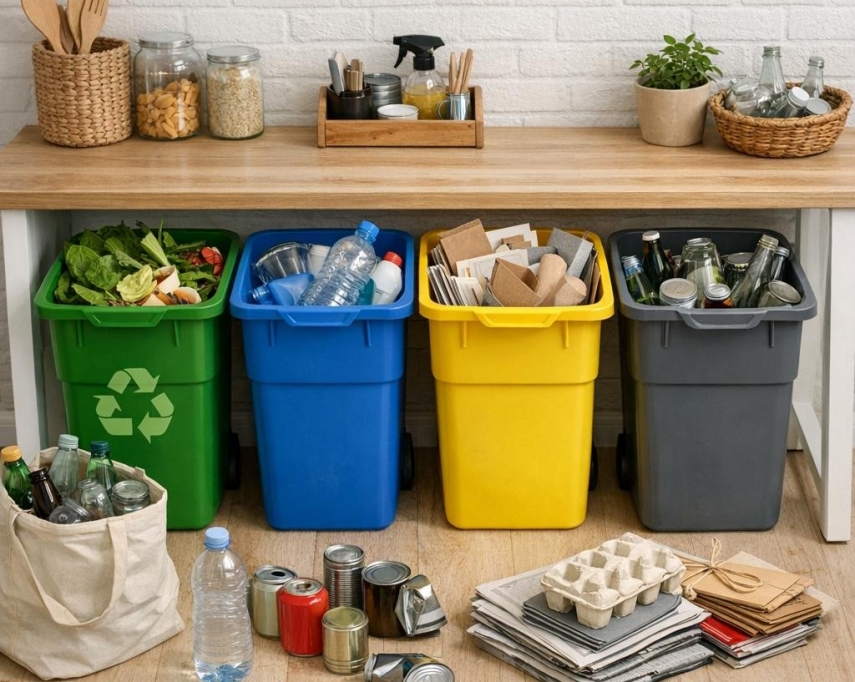
A good recycling setup makes sorting feel automatic rather than like another household chore. The best recycling station ideas give paper, plastic, glass, cans, and other accepted materials clear places to go while keeping containers easy to empty, clean, and reach.
The goal isn’t to create a large recycling center inside the house. A compact, carefully placed system often works better because everyone can understand it at a glance.
Start With the Waste Your Household Actually Produces
Before buying bins, look at what fills your trash and recycling during a normal week. Some homes generate large amounts of cardboard and beverage containers, while others need more room for paper, food packaging, or glass.
Your local recycling rules matter too. A sorting system with six compartments offers little benefit if your collection service combines most recyclable materials.
Match Container Size to Volume
Give the largest container to the material you produce most often. Paper may need a broad bin, while batteries or small electronics may only need a small temporary collection box.
This approach also prevents half-empty containers from taking over valuable kitchen or utility-room space.
Choose a Location That Supports Daily Habits
The most effective station is usually close to where recyclable waste is created. Kitchen cabinets, pantry edges, mudrooms, garages, and utility spaces are common choices.
People exploring practical home styling resources can also borrow ideas from general storage planning: containers work better when their location follows normal movement through the house instead of forcing an extra trip.
Keep the station near enough to use easily but away from narrow doorways and busy floor paths.
Make Each Recycling Category Obvious
Labels should be easy to read before someone opens a lid. Words such as “Paper,” “Cans,” and “Glass” often work better than decorative labels that require interpretation.
Color differences can help, but don’t depend on color alone. Written labels make the station easier for guests and children to understand.
| Station Feature | Useful Choice | Main Benefit |
|---|---|---|
| Paper storage | Wide dry bin | Holds flattened items |
| Bottles and cans | Washable container | Handles residue easily |
| Small recyclables | Compact labeled box | Prevents mixing |
| Overflow items | Garage backup bin | Controls indoor clutter |
Build the Station Into Existing Storage
Not every recycling center needs to remain visible. Pull-out cabinet bins, deep drawers, pantry cubbies, and under-counter containers can keep sorting close to the kitchen without dominating the room.
Broader household organization ideas can be useful inspiration because recycling storage follows the same principle as other successful systems: frequently used items should have predictable homes.
If cabinet space is limited, narrow stacking bins can use vertical space without creating a wide footprint.
Plan for Emptying and Cleaning
A recycling station fails quickly if bins are difficult to carry outdoors. Choose containers that can be lifted comfortably and removed without shifting furniture.
Ideas from space-planning inspiration can also help with placement. Leaving enough clearance in front of bins matters more than squeezing one extra container into the available space.
Washable surfaces are valuable around bottles and cans because small spills can create odors.
Mistakes That Make Recycling Stations Messier
One common mistake is creating too many categories. Excessive sorting can confuse household members and encourage items to pile up beside the station instead of inside it.
Another problem is choosing attractive baskets that are difficult to clean. Recycling containers handle packaging residue, so practicality should carry more weight than appearance.
Avoid placing the station where doors, stools, or appliances block access. A system that’s inconvenient during busy moments usually stops being used consistently.
Frequently Asked Questions
Where is the best place for a home recycling station?
The kitchen, pantry, mudroom, garage entry, or utility area usually works well. Choose a location close to where packaging is discarded while keeping enough room to remove full containers comfortably.
Should recycling bins have lids?
Lids can hide visual clutter and contain minor odors, but open bins are faster to use. The better choice depends on the material being stored and how visible the station is.
How can I fit recycling bins into a small kitchen?
Use narrow pull-out bins, stackable containers, under-counter storage, or a nearby pantry. Prioritize the recycling categories your household produces most instead of creating a separate large bin for every possible material.
Make Sorting Easy Enough to Become Automatic
A tidy recycling station succeeds through convenience, not complexity. Start with your household’s actual waste pattern, provide clearly labeled containers, and place them where recycling naturally happens.
Check the setup after a few weeks. If one bin constantly overflows or another stays nearly empty, resize the system. A station that adapts to real household habits will stay cleaner and remain useful far longer.